It’s undeniable that the way people find and book travel has been going through a shift. Imaging someone looking to book a boutique hotel in Lisbon: maybe Google searching hotels, visiting websites, and then making a booking. This way of booking hasn’t disappeared, but it now exists along a whole new way of researching and booking travel that’s important for any hospitality brand to consider. In the new scenario, a traveler might instead start by asking an AI assistant about “the best boutique hotel in Lisbon with a rooftop pool,” then scan the names, information, and prices directly in the AI chatbot, and book based on that answer.
What’s the difference? In scenario two, the traveler never actually visits a hotel website. This is what’s called zero-click search, and this change in the digital guest journey carries significant marketing impacts for hotel brands.
What Is Zero-Click Search?
Zero-click search happens when a traveler gets their answer and makes a booking, all without clicking through to a hotel’s website.
There used to be one typical way of booking a trip online. A search engine would show a list of links, and the traveler would explore hotel websites, compare options, and then book. Now, with hotel and travel information appearing directly inside AI chatbots like Claude, ChatGPT, or Gemini, travelers can essentially decide about their hotel booking without visiting a single website.
They could still wind up on a hotel website to book, but since booking aggregators are often directly linked in that AI conversation, it’s incredibly easy for travelers to book through a third-party platform.
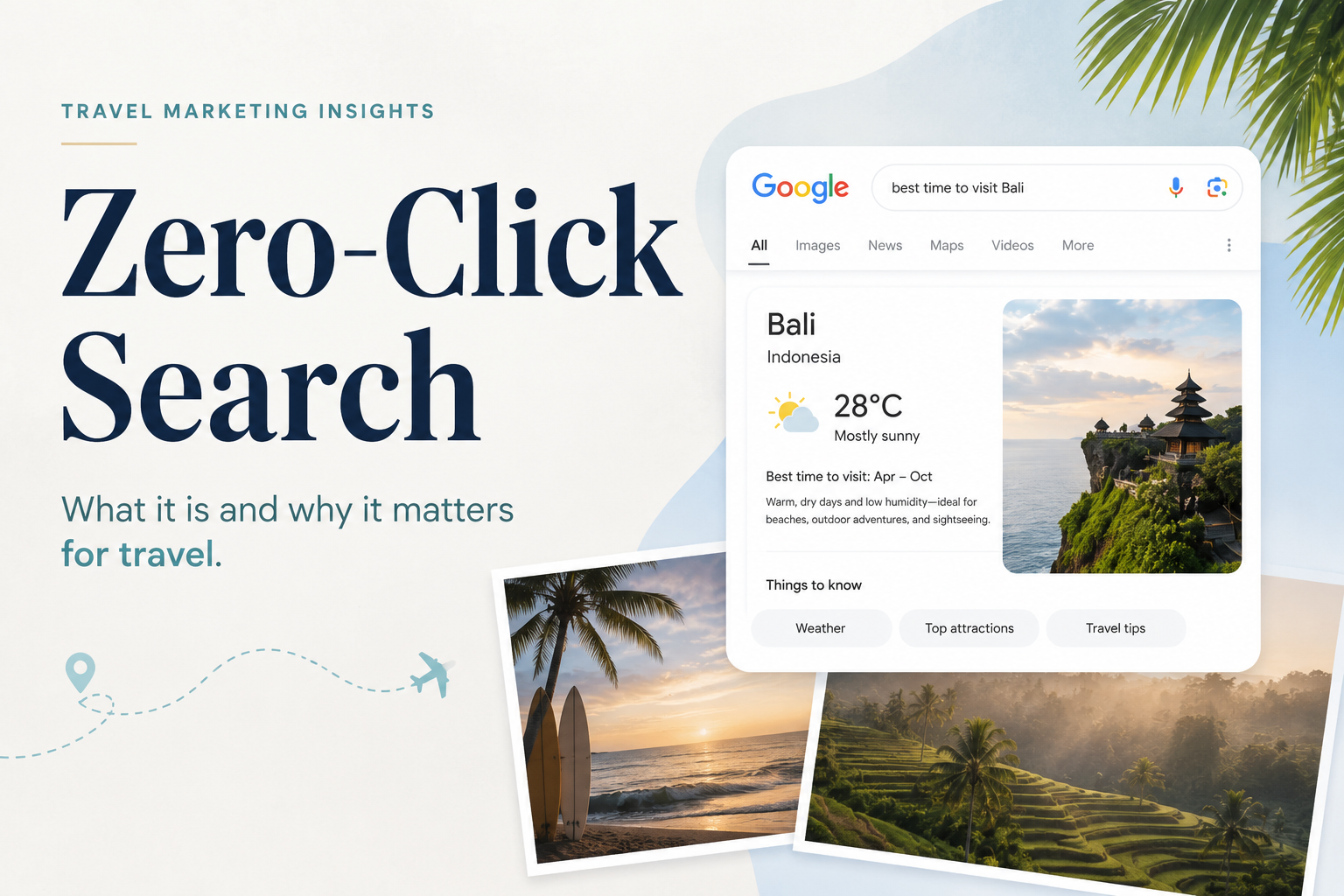
Google AI overviews and featured snippets play into this, as well. Imagine a scenario when a traveler Google searches “best hotels in San Diego for traveling with pets.” They might first come across your hotel in an AI overview at the top of the search results, instead of having to scroll through different hotel listings.
Why This Matters Specifically for Travel
This change in how search happens isn’t specific to the travel industry. But, the travel industry is especially impacted, and it’s important for your brand to stay up-to-date to understand how to adjust and adapt.
Travel is a high-consideration purchase category. It’s not a quick two-second decision, and is an industry where guests often heavily research before booking and making a decision. There’s lots involved in the guest journey to make a decision, from checking reviews to browsing through photos to price comparisons.
AI has had such an impact on the travel industry for this reason. This type of research pattern is exactly what AI tools tend to be good at: summarizing information from a range of sources in a single, easy-to-understand way.
Booking aggregators and OTAs (sites like Booking.com, Expedia, and TripAdvisor) already sit as a layer between hotels and guests. You can think about AI as an added layer on top of that existing dynamic.
Here’s why that matters for hotels now: guests are forming opinions about properties before ever reaching the hotel’s website. Even if they do click-through to your website after reading an AI summary, they’ve potentially already formed a perception or opinion about your brand beforehand.
The reality is that there’s a range of places where a potential guest might encounter your hotel before visiting your property website. Beyond AI summaries and responses, they also could find it through TripAdvisor, Google Maps, social media and influencer content, and review aggregation websites. The key point about AI is that travelers are often heavily using it within their research process and relying on it through complex conversations.
How Does AI Shape Guest Perceptions of Hotels?
Another key difference to keep in mind is that AI tools and aggregators don’t necessarily prioritize a hotel’s own website as a source when they’re putting together an answer.
Instead, they’ll pull from whatever is easiest for the AI to parse and is most consistently structured. Instead of a hotel website, that might be review platforms like TripAdvisor or Google, OTA listings, third-party travel content like travel blogs, and more.
What Are the Risks for Hotel Brands?
Risk 1: Less Brand Depth
The unique positioning and storytelling of your brand could get reduced to generic bullet points in an AI summary or response. Instead of the whole brand story and feel that your team spent time crafting, a searcher could just see a sentence like “modern hotel with pool and bar.”
This doesn’t mean your brand doesn’t matter. In fact, it’s arguably more important than ever as searchers are exposed to your brand in multiple channels. Instead, it just means that people might not see that upfront or immediately in an AI-generated result.
Risk 2: Inaccurate or Incomplete Info
Since the information isn’t directly on your website, there’s a risk that outdated or inaccurate information could get shared. Maybe the seasonal pool at your hotel is listed on a ChatGPT response as year-round, a boutique independent property gets included as part of a chain, outdated room types could get presented, or pricing might be out of date.
This can all happen since AI tools typically put a lot of weight in guest reviews. This is just how AI tools are designed, and information isn’t meant to be inaccurate.
What Does This Mean for Hotel Visibility?
Website traffic is no longer a complete picture of visibility
Website traffic used to be the main indicator that people were finding your hotel. If your website had lots of traffic and visits, it meant that your marketing efforts were working. But now, there’s much more to consider, and website traffic isn’t the strong indicator it used to be.
A hotel can be highly visible without generating a huge amount of traffic. Consider a website that appears in AI answers, map results, and aggregator listings, and earns bookings without website visits. With that in mind, website traffic has shifted from a primary visibility metric to part of a more dynamic whole.
Answer engine visibility is an emerging metric
With AI tools playing a larger role, having your brand show up on AI overviews and through AI chatbots is a new measure to track. If your hotel doesn’t appear in any AI search results, you could be losing out on a segment of customers who are discovering hotels and making decisions this way.
How Should Your Hotel Adapt?
Hotels can’t opt out of zero-click search, but you can help influence how your hospitality brand appears within it. What hasn’t changed is that your hotel’s brand, story, and website all still deeply matter. Think of AI results as just another layer to consider in your marketing efforts.
Here are a few action items to keep in mind for optimizing for AI:
- Audit listing accuracy across all platforms (Google Business Profile, TripAdvisor, OTAs), not just the hotel’s own site
- Keep structured data / schema markup on the website current and detailed (not sure what this is? Get in touch to decode your website)
- Write clear, distinctive property descriptions. Having a strong brand can help resist your property being flattened into generic AI responses
- It’s best practice to regularly ask AI tools directly about your property as a way to verify if accurate information is being presented
- Knowing how important reviews are for AI summaries, respond to and manage hotel reviews
- Bring in AI visibility into your marketing efforts
How to Measure ROI from Zero-Click Searches
Since zero-click searches skip your website entirely, standard metrics like sessions, clicks, and on-site conversion rate won’t capture it — you need proxy signals instead. A few to track:
- Branded search volume: a rise in searches for your hotel’s name (via Google Search Console or Trends) often means someone encountered your brand through AI or an aggregator first, then came looking for you directly.
- Direct and type-in bookings: as a share of total bookings, this can signal guests who already decided on you before visiting your site.
- Google Business Profile insights: calls, direction requests, and website clicks sourced from Maps and GBP, rather than organic search alone.
- AI visibility tracking tools: an emerging category of tools now tracks how often and how accurately your property is cited in AI answers, similar to a share-of-voice metric.
- Guest-reported source data: asking “How did you hear about us?” during booking or checkout gives you a direct read on AI/aggregator-influenced bookings that no analytics platform will show you.
- Review volume and sentiment: since AI tools weight reviews heavily, improvements here often track with better AI visibility and accuracy.
Because none of this shows up in a single dashboard, ROI here is best measured as a blended, quarterly view — brand lift, AI share of voice, and booking channel mix — rather than a single number.
A Few Key Takeaways
When planning your hotel’s marketing strategy, it’s essential to keep in mind that the guest journey now starts earlier than most hotels are currently tracking. AI is one of the many channels where people could start forming opinions about your brand, and this shift is key to be aware of.
By the time a potential guest reaches your hotel website, they may have already formed a general opinion or impression, compared your hotel with competitors, and made most of the decision.
With this in mind, it’s important for your hotel to show up clearly and accurately where guests are actually looking. And, for your website to consistently represent your brand, so visitors both get the information they need and clearly understand your hotel’s unique story.
Curious how your brand is currently appearing in AI search tools? Or, interested in personalized insights about how your hospitality brand can adapt to this changing landscape? Get in touch with us at Wallop to learn more.